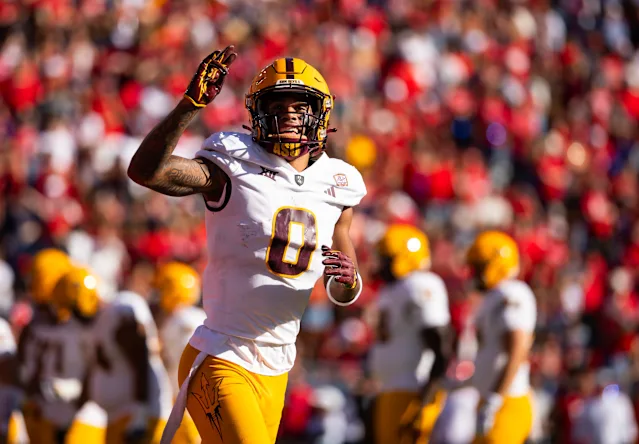
Jordyn Tyson might be one of the most natural fits for the Washington Commanders in the upcoming NFL Draft. At a time when the franchise is trying to build a modern, explosive offense around a young quarterback, Tyson offers exactly the type of wide receiver profile that accelerates development. He combines NFL-ready size, refined route running, and an increasingly reliable set of hands that have quietly become one of the biggest growth areas in his game.
Tyson enters the draft as a polished perimeter receiver who already understands how to win against high-level defensive backs. At 6-foot-2 and roughly 203 pounds, he has the frame teams want for an outside receiver while still maintaining the fluidity and body control that allow him to separate consistently. That balance between size and movement skills is what immediately stands out on tape. He isn’t simply a physical receiver who wins with strength, nor is he just a speed threat relying on athleticism. Tyson’s game is built on the details, and those details make him particularly attractive for an offense like Washington’s.
Separation is one of the most valuable traits a receiver can bring to the NFL, especially for a young quarterback learning to read defenses and trust timing routes. Tyson excels in this area. He consistently creates throwing windows through route pacing, leverage manipulation, and sharp breaks at the top of his routes. Instead of relying purely on vertical speed, he uses tempo changes and subtle head fakes to force defenders into poor positioning before snapping off his cuts.
That skill translates immediately to the professional level. Many college receivers dominate because they are simply more athletic than the defenders they face. When they reach the NFL, where every cornerback is an elite athlete, those advantages disappear. Tyson’s game doesn’t rely on those advantages. His route running is already built on technique and nuance.
Scouting reports have repeatedly highlighted this trait. Evaluators describe Tyson as a receiver who “displays smooth route running and acceleration with crisp breaks that consistently create separation.” That kind of description is exactly what offensive coordinators want to hear when evaluating receivers who must function in timing-based systems.
The Washington Commanders’ offense is built around rhythm and spacing concepts. Routes are designed to create defined reads for the quarterback, often requiring receivers to be exactly where they are supposed to be when the ball comes out. Tyson’s route discipline makes him an ideal candidate for that type of scheme. He understands leverage, how to stem routes against different coverages, and how to maintain balance through his breaks.
Another element that makes Tyson such an intriguing prospect is the completeness of his route tree. Arizona State deployed him across multiple alignments, allowing him to attack defenses in different ways depending on the matchup. He lined up as an outside X receiver, worked as a Z receiver in motion, and spent time in the slot creating mismatches against nickel defenders and linebackers.
This versatility matters for a team like Washington that values pre-snap motion and formation shifts. Instead of being locked into one position, Tyson can move around the formation to create advantageous matchups. A receiver who can play multiple roles makes defensive game planning significantly more difficult. If a cornerback struggles to stay with him, the offense can isolate that matchup. If defenses attempt to bracket him outside, he can shift into the slot and attack the middle of the field.
While his route running and separation skills have always been strong, one of the biggest developments in Tyson’s game has been his improvement as a pass catcher. Early in his college career, drops were occasionally a concern. His hands were sometimes inconsistent, particularly when transitioning from route break to catch point. That inconsistency showed up in his drop rate, which hovered around the seven to eight percent range during parts of his early production.
However, Tyson addressed that weakness in a meaningful way. Over the last year, his ball skills have taken a noticeable step forward. His hands have become stronger and more confident, and he has improved significantly at attacking the football instead of waiting for it to arrive.
Draft analyst Todd McShay specifically highlighted that improvement while discussing Tyson’s development, noting, “Tyson made huge strides with his ball-skill consistency this past year. I specifically love how he’s started aggressively attacking throws in the air.” That change in mentality has made a difference. Instead of allowing defenders to close on passes, Tyson now consistently meets the ball at its highest point.
This development is critical because it unlocks another part of his game: contested catches. Tyson has always had the physical tools to win in tight coverage. His length, body control, and ability to track the football make him dangerous when the ball is in the air. What has changed is how confidently he finishes those plays.
On film, Tyson shows impressive body control along the sideline and in traffic. He tracks deep passes smoothly over his shoulder and adjusts mid-air to off-target throws. When defenders attempt to disrupt him at the catch point, he maintains balance and extends his arms away from his body to secure the football.
These traits become especially valuable in the red zone. Inside the 20-yard line, space shrinks and separation becomes harder to create. Receivers who can win above the rim or finish through contact often become primary scoring weapons. Tyson’s ability to high-point the ball and maintain control through contact suggests he could fill that role at the next level.
Production backs up the evaluation. Tyson’s breakout season at Arizona State showcased what he can do when given a full workload. During that year he recorded 75 receptions for 1,101 yards and 10 touchdowns, numbers that earned him Third-Team All-American recognition and Big 12 Offensive Newcomer of the Year honors. Those statistics reflect not only talent but also the ability to handle the responsibility of being a primary target in an offense.
Even in seasons where injuries limited his availability, Tyson continued to produce efficiently. In one shortened campaign he still managed 61 receptions for 711 yards and eight touchdowns, showing that when he is on the field he consistently impacts the passing game.
For Washington, this level of production is appealing because the offense needs a reliable playmaker who can command targets. Developing quarterbacks benefit from receivers who can create separation quickly and provide a trustworthy option on critical downs. Tyson’s skill set fits that role naturally.
Another reason Tyson makes sense for Washington is his ability to stretch the field vertically. While he is known for his route running, he also has the acceleration and long speed necessary to threaten defenses deep. Safeties must respect that vertical element, which forces defensive structures to expand. When safeties retreat to protect against deep routes, intermediate and underneath zones become more vulnerable.
That ripple effect can transform an offense. Tight ends find more room between linebackers and safeties. Slot receivers operate with more space across the middle. Running backs benefit from lighter boxes and fewer defenders crowding the line of scrimmage. A receiver who commands vertical attention opens opportunities for everyone else.
Tyson also brings a competitive mentality that coaches appreciate. Throughout his career he has shown toughness playing through injuries and continuing to contribute to his team. Those experiences helped shape his approach to the game and built a reputation for resilience.
That mindset aligns with the cultural direction Washington is trying to establish. The Commanders have emphasized accountability, work ethic, and competitiveness as core pillars of the roster they are building. Players who match those traits are prioritized during the draft process, and Tyson appears to fit that mold.
Another underappreciated factor in Tyson’s development is the influence of former NFL star Hines Ward, who worked with him during his time at Arizona State. Ward’s presence helped refine several aspects of Tyson’s game, including his blocking technique and physical play style. Ward has long emphasized toughness and attention to detail among wide receivers, traits that are increasingly visible in Tyson’s film.
Learning under a coach with Ward’s experience can accelerate a receiver’s transition to the professional level. Tyson already displays many of the habits that coaches expect from veteran receivers, such as maintaining discipline in his routes and fighting for positioning against defensive backs.
Of course, no prospect enters the draft without concerns. Tyson’s injury history will likely be the biggest topic teams evaluate during the pre-draft process. His career has included several setbacks, including knee and collarbone injuries along with periodic hamstring issues. Medical evaluations will determine how comfortable teams feel investing in him early in the draft.
However, when healthy, Tyson’s tape shows a receiver capable of producing at a high level against top competition. His skill set aligns with the direction modern NFL offenses are heading. Teams increasingly value receivers who can create separation quickly, operate across multiple alignments, and contribute at every level of the field.
Tyson checks each of those boxes. His combination of size, technical route running, improved hands, and positional versatility gives him one of the more complete profiles among receivers in the draft class. Some evaluators have even compared aspects of his play style to receivers like Justin Jefferson, CeeDee Lamb, and Brandon Aiyuk, players known for their ability to blend route-running precision with explosive playmaking.
For Washington, a player with that type of upside could become a cornerstone of the passing game. The Commanders are still building their offensive identity, and adding a receiver who can develop into a true No. 1 target would accelerate that process significantly.
If Tyson reaches his ceiling, he projects as a receiver capable of commanding defensive attention every week. His route running can generate consistent separation, his improving hands make him a dependable target, and his ability to win at multiple levels of the field keeps defenses guessing.
That kind of receiver can change the dynamic of an offense. For the Washington Commanders, Jordyn Tyson represents more than just another draft pick. He represents a player whose skill set fits exactly what the franchise is trying to build as it moves forward.